The Time and Effort on Task Toolkit is an easy-to-use tool that can help you to plan and complete your assessments. It focuses not just on the output as words or minutes, but also on the effort and time you will need to complete your assignments.
The tool is designed for use:
- When you begin an assessment, to help you understand what is expected and how to plan your time and effort.
- In the classroom, when your tutor introduces the assessment task.
- Across your course, to help you manage your workload each semester and understand how different assessments are integrated to support your knowledge acquisition, and skills development
How this tool can be used
When starting a new assessment task:
- To evaluate what knowledge or skills you may need to revisit.
- To break down the task and understand what is involved at each step.
- To estimate how long each part of the task will take
- To support your understanding of the task and improve how you approach it in future.
Note: It is not expected that this tool will be applicable to all types of assessments at all levels
Planning your assessment through a “Time-and-Effort” lens
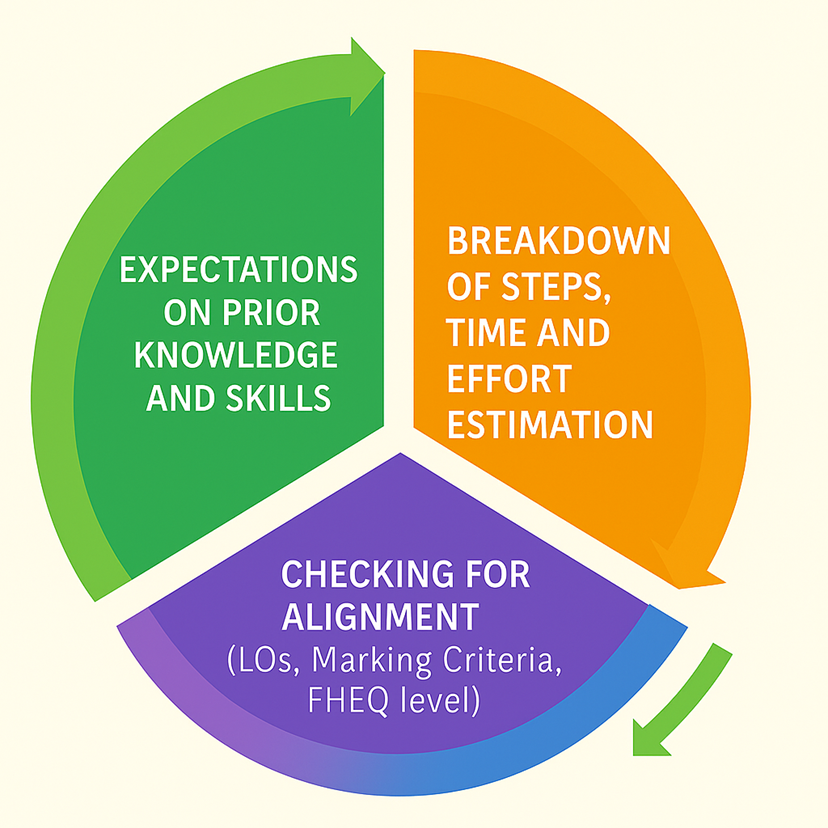 |
Assessment output tends to be defined in terms of word-count (e.g. in essays) or time (e.g. in presentations). However, fewer words can, in fact, make an assessment more challenging, and often the time and effort requirements are overlooked and underestimated. By looking at your assessments through a “Time-and-Effort” lens, you can get the necessary guidance and support to complete the assessment task. When considering ‘Time-and-Effort’, a good place to start is to consider the notional hours for your module, and through that how many hours should be allocated to your assessment. Note that although a 20-credit module equals 200 notional hours of learning, this does not mean you will spend all 200 hours on assessment tasks. Using the notional hours as a starting point, the following three steps (Fig 1) can help you plan and approach your assessment. Through the application of the “Time and Effort” lens you can develop your assessment literacy and be successful from the first attempt. The steps are interlinked and you don’t have to follow them in this exact order. |
Step 1: What do you need to know and/or be able to do, that is required for the assessment, but you are not learning as part of the module
Key Idea
| There might be skills and knowledge that you are expected to have, even if these were not directly taught in your current module. |
Why this matters
Frequently, Frequently, you will be expected to rely on your prior knowledge and skills to allow you to complete an assessment task. For instance, if you are asked to prepare a presentation, it is assumed you are familiar with public speaking and possibly with the use of presentation software such as PowerPoint. Or if you are writing a report, it is expected that you have some prior knowledge and experience with the specific assessment type. It is important to remember that your skills may be different than other students, as all students come from different entry points, and you might have different strengths or require support for different requirements of the assessment.
By identifying what the expectations are, you can reflect on your abilities by:
- Reflecting on past experiences from other courses
- Revisiting prior assessments from your current course
- Engaging with past feedback
In that way, you can identify the areas that you may need more support with and where you can find the relevant You can also ask your tutor for further resources and guidance that may help you to refresh your skills and knowledge. Step 1 of the toolkit is designed to help you with that.
Time and Effort on Task Templates
You can use a structured template (see template for students) to help you to:
- List pre-existing skill and knowledge
- Identify available resources to to help you refresh your knowledge and further develop your skills. (e.g. workshops, prior modules, university-wide support)
Recommendations on using the templates
You can use the templates on your own for your personal reflections.
You can collaborate with your peers for exploring the assessment requirements and where to find additional support.
Your tutor may use the templates during class time for co-creation and open discussion of assessment requirements and assessment planning.
Step 2: Time-and-Effort estimation: What are the steps that you need to take to successfully complete the assessment task and how long each of them would take?
Key idea
| Break down your assessment tasks into clear steps that you need to take in order to complete the assignment. |
Why this matters:
Different students require a different amount of time to complete similar tasks, especially at different stages of their course. As you progress through your course, you will gain experience of performing similar tasks and develop further the relevant skills. It is therefore possible that the same type of task could take less time for you at higher levels (e.g., compiling a bibliography, using Excel etc.).
Breaking down assessment tasks into indicative steps that you need to take in order to complete the assignment can be helpful. Step 2 of the toolkit takes this a bit further. You can use the structured template (see template for students) to help you to:
- Break down assessment tasks into indicative steps that you need to take in order to complete the assignment
- Estimate the time that you think you will need to complete the step based on your own experience and skills
- Estimate how much effort will that require of you
- Set your own mini-deadlines
- Identify relevant resources that can help you with the steps that you find more challenging
Recommendations on using the templates
You can use the template on your own for your personal assessment planning. Your tutor may use the templates during a session when assessment requirements are discussed. You can aso use the templates together with your peers. Other students may have different ways of approaching the same task, sharing your different approaches can help you learn from each other. It can also help with sharing resources that others have already used successfully.
Certain steps could be included in most assessment tasks and help you improve your feedback and assessment literacy, independently of the type of assessment at hand. Those steps can be discussed during class time as well. Types of such steps include:
- Reflection on past feedback
- Self-evaluation using marking criteria and rubrics
- Discussing with peers
- Analysis of past exemplars
Step 3: Final checks for maximising success
Key idea
| Once you have broken your assignment into steps, it is important to reflect and consider if the recommended steps are aligned with other key factors such as the marking criteria and the module and course learning outcomes. |
Why this matters
The steps that you are asked to complete need to be aligned with what is being assessed, to ensure that you meet key expectations and use your time and effort wisely.
Time and Effort on Task Templates
The available template (see Template for students) can be used to confirm the suitability of the steps identified for the assessment task.
 Are the steps covering the whole task?
Is it possible that something may have been missed? If so, adapt your plan.
 Are the steps selected relevant to the marking criteria? Are there any steps that need to be added, altered or removed?
Are all the steps that you’ve selected relevant and will they help you meet all of the criteria ?
Example 1: You have been asked to develop a website. A step could be added in the breakdown of the assessment task to work on the appearance and graphics of the website, and for this step you have estimated 1 hour with high effort requirements as you haven’t done something like that before. When you go back and compare the steps with the marking criteria, you realise that the marking criteria do not talk about to the appearance/graphics of the website but only the content and the sources used. That helps you to adapt your plan and reduce the time you have planned to invest for the appearance of the website.
Example 2: You have been asked to write a report supported by the literature. You have added several steps in your planner such as doing a literature search, writing the report, and proof-reading. When you review and compare your steps with the marking criteria, you see that 10% will be given for an accurate reference list. By doing this comparison, you now have added an additional step [producing and checking the reference list] that may increase your final mark by up to 10%.
 Is the total estimated amount of time realistic, for the grade you are aspiring to achieve?
Here you can consider how much of the module, this assessment is worth (e.g. 100%, 50%). You can also take into account if you have any other commitments from within the course and/or your personal life. Can you realistically invest the time and effort you have identified? If no, what changes can you make to your plan?
 Do I understand what skills and knowledge will be developed by this assessment task, to support future success on the course and beyond?
Find out more on GUIDANCE FOR STAFF

The toolkit and all associated resources are licensed under CC-BY-NC-SA 4.0
This toolkit and all associated resources are an output from a Collaborative Enhancement Project supported and funded by QAA membership. The project is led by Coventry University in partnership with Aston University, International University of Applied Sciences, Germany, University of the West of Scotland, and University of West London. Find out more about Collaborative Enhancement Projects on the QAA website.
